Islamic Inheritance (Faraid) Guides
New to faraid? Start with who may inherit, then learn how to calculate shares from the net estate and follow worked examples. Our source-based guides explain the four Sunni schools and include country-law topics.
- Based on classical sources
- All four Sunni schools
- Free calculator
New to faraid? Start with these three guides
Follow this order: learn who may inherit, see how the calculation works, then study solved examples.
- 1
Islamic Inheritance Shares: Who Gets What?
Learn the main heirs and how closer relatives can affect inheritance.
- 2
How to Calculate Faraid: A Step-by-Step Guide
See how to identify the net estate and work out each share.
- 3
Faraid Calculation Examples: 8 Solved Islamic Inheritance Cases
Follow fractions and amounts through common family cases.
Faraid guides
16
Islamic Inheritance Shares: Who Gets What?
Shares of spouse, daughter, son, mother, father and siblings in Islamic inheritance law; exclusion (ḥajb), impediments to inheritance and examples — explained with classical sources.

How to Calculate Faraid: A Step-by-Step Guide
Faraid in four steps: funeral costs, debts, bequest and the division of shares. Worked example, common mistakes and a free online faraid calculator — with classical sources.

Faraid Calculation Examples: 8 Solved Islamic Inheritance Cases
8 solved faraid cases: spouse and children, parents, ʿUmariyyatān, ʿawl, radd, exclusion and Mushtaraka, with fractions, amounts and school differences.

Islamic Inheritance Share Table: Shares, Conditions and Exclusions
Faraid share table for spouses, parents, grandparents, daughters and siblings: each share's condition, who excludes whom and where the four schools differ.
Faraid Differences Between the Four Sunni Schools
Does the inheritance calculation change by madhhab? Grandfather and siblings, al-Mushtaraka, radd and dhawū l-arḥām in the four Sunni schools — compared with classical sources.

The Spouse's Share in Islamic Inheritance: What Do the Husband and Wife Receive?
A husband takes 1/2 or 1/4 and a wife 1/4 or 1/8. Several wives, divorce, the waiting period (idda) and divorce in final illness, with worked examples.

Children's Share in Islamic Inheritance: What Do the Daughter and Son Receive?
One daughter takes 1/2, two or more daughters 2/3; with a son, a male takes two parts and a female one. Grandchildren, siblings and calculated examples.

Munasakha: What Happens When an Heir Dies Before the Estate Is Divided?
What happens if an heir also dies before the estate is divided? The definition of munasakha, how to merge two deaths into one table and a case from al-Mughni.

ʿAwl and Radd: When the Shares Exceed or Fall Short of the Estate
ʿAwl: when the fixed shares exceed the estate, all shrink in proportion. Radd: with no residuary heir, the surplus returns to the sharers. Examples and school differences.

Ḥajb: Exclusion and Reduction of Shares in Faraid
Total exclusion (ḥajb ḥirmān) and partial exclusion (ḥajb nuqṣān): which relative removes or reduces which heir, with a worked example and the difference from impediments.
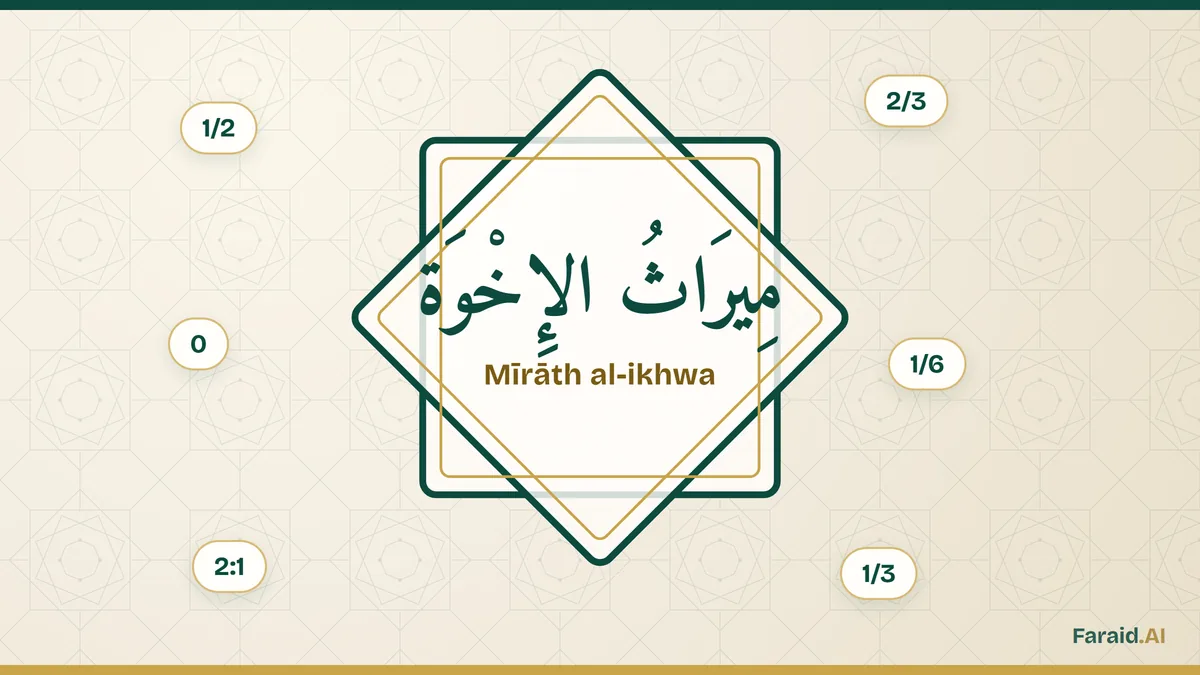
Siblings' Share in Faraid
Siblings in Islamic inheritance: when full, paternal and maternal siblings inherit, the 1/2, 2/3, 1/6 and 1/3 shares, the 2:1 rule and worked examples.

Inheritance of a Missing Person (Mafqūd) and the Waiting Periods
What happens to the estate and the share of a person whose fate is unknown? Ḥanafī 90 years, Mālikī taʿmīr period, Shāfiʿī judge's ruling, Ḥanbalī 4 or 90 years; worked example.

Inheritance of the Khunthā Mushkil in the Four Schools
How does an heir whose sex cannot be determined (khunthā mushkil) inherit? The lesser share in the Ḥanafī school, the average in the Mālikī, reservation in the Shāfiʿī and Ḥanbalī.

The Unborn Child's (Ḥaml) Share: Dividing the Estate Before Birth
How is an estate divided when one of the heirs is not yet born? The Ḥanafī fatwa, Ḥanbalī, Shāfiʿī and Mālikī views, the reserved share and a worked example.

Dhawū al-Arḥām: When Aunts, Uncles and a Daughter's Children Inherit
Relatives who are neither sharers nor residuaries (dhawū al-arḥām): when they inherit, the Ḥanafī and Ḥanbalī versus Mālikī and Shāfiʿī views, the methods and an example.

Bequests in Islam: the One-Third Limit and the Obligatory Bequest
A bequest may not exceed one third of the estate after debts, and a bequest to an heir needs the other heirs' consent. The obligatory bequest (waṣiyya wājiba) in modern laws.
Country and law guides
2
Faraid in England and Wales: What English Law Allows
How intestacy rules, the Wills Act, 1975 Act claims, deeds of variation and inheritance tax affect a faraid distribution in England and Wales — with the statutes cited.

Faraid in the United States: What State and Federal Law Mean for Islamic Shares
How a faraid distribution works with US state succession law: wills, community property, the spouse's elective share and the 2026 federal estate tax exclusion — with sources.
Calculate your family's shares
Enter the heirs and get the result for all four schools, with fractions and reasoning.